Does your school need a new website?
A practical guide to deciding whether to improve, refresh or start again
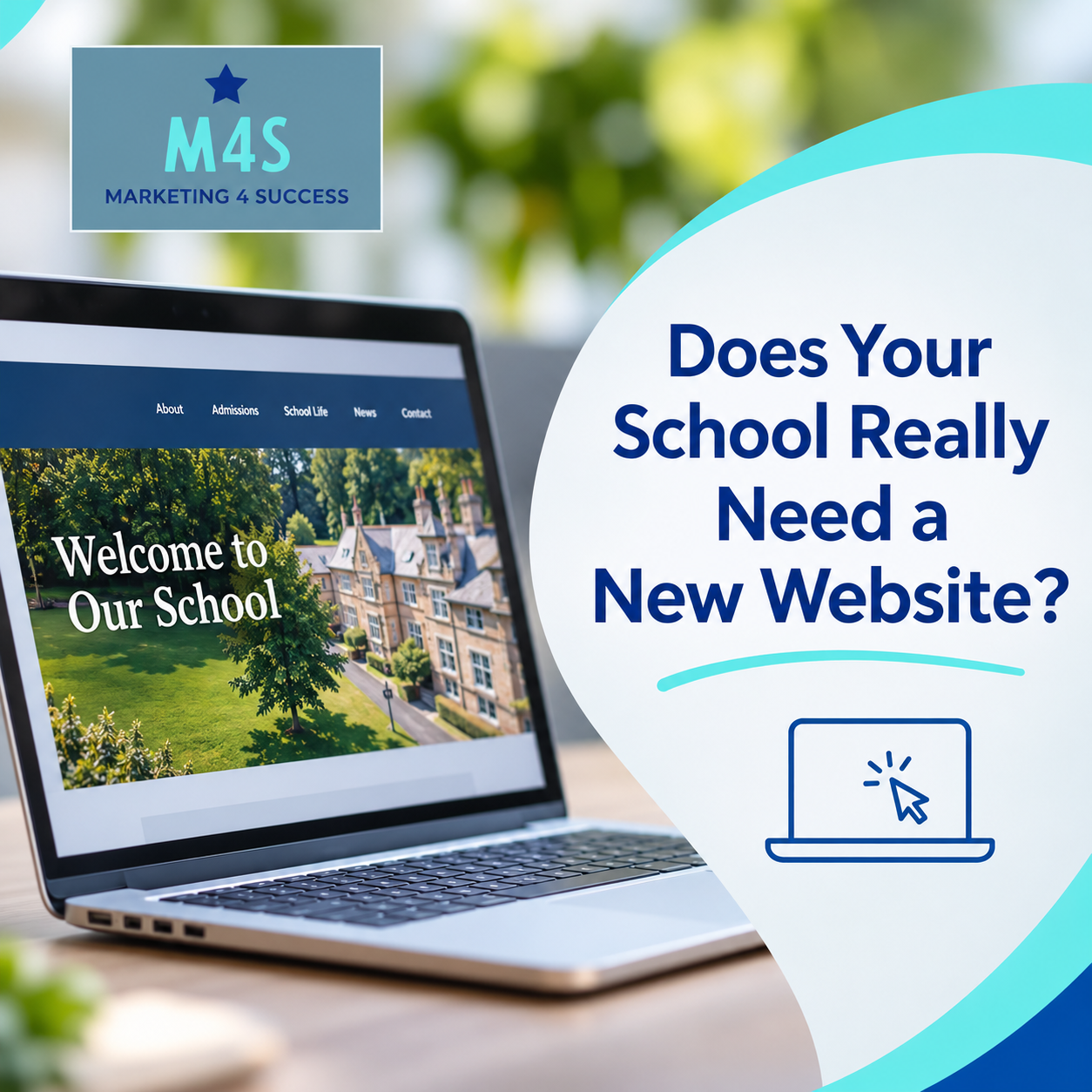
“We need a new website.”
Is a sentence I hear fairly regularly from schools.
And sometimes, they absolutely do.
The website may be technically outdated, difficult to manage, poorly integrated with other systems or simply no longer capable of delivering what the school needs.
But sometimes, when you start digging a little deeper, the answer isn’t necessarily a completely new website.
Perhaps the structure needs simplifying. The messaging has become diluted. The admissions journey isn’t clear enough. Years of adding pages have made navigation increasingly complicated. Or the website simply no longer reflects the school as it is today.
And there’s another increasingly important question: how easily is your school being found in the first place?
Search is changing. Prospective families may still start with Google, but increasingly they are also using AI-powered search and tools such as ChatGPT to research and compare schools. Your website content therefore needs to be clear, authoritative and structured so that both search engines and AI tools can understand who you are, what you offer and why you might be relevant to a particular family.
None of those things automatically means you need a new website.
So, before embarking on what can be a significant investment of both money and time, there’s a more useful question to ask:
What problem are we actually trying to solve?
Start with the prospective parent
One of the challenges of reviewing your own school website is that
you know too much.
You understand the structure of the school. You know the terminology, where information lives and which section to click on to find it.
A prospective parent doesn’t.
They arrive with questions.
Is this the right school for my child?
What makes it different?
Can I picture my child here?
How does admissions work?
What should I do next?
Your website needs to help them answer those questions quickly and intuitively.
So rather than simply reviewing individual pages, look at the journeys you want prospective families to take.
Search for your school as they might. Arrive through different pages. Try to find key information. Follow the admissions journey. Look at the site on your phone. And try, however difficult it may be, to forget everything you already know.
Could your existing website simply work harder?
A website can feel tired without necessarily being technically obsolete.
Often, the underlying CMS is perfectly capable of doing what the school needs, but the content and structure have evolved over several years.
Pages get added. Navigation grows. Calls to action become inconsistent. Old content remains. What feels logical internally gradually becomes rather complicated externally.
A thorough website audit can establish what’s working, what isn’t and where improvements could have the greatest impact.
The answer might be restructuring sections, rewriting content, strengthening messaging, simplifying journeys, improving SEO and calls to action, or simply making better use of functionality you already have.
Sometimes a programme of focused improvements is all that's needed.
And sometimes you really do need a new website
There comes a point when continuing to adapt the existing website is no longer the best use of time or budget.
Technology may be limiting what you can achieve. Integrations with other systems may be cumbersome. The CMS may be frustrating for your team to manage. Or perhaps the school itself has changed significantly since the website was commissioned.
If that's the case, a new website can absolutely be the right decision.
But deciding you need one is only the beginning.
Do the thinking before you approach agencies
Over the past year, I’ve supported three schools preparing to commission new websites, helping them develop their briefs and identify suitable agencies to shortlist.
And it is a much more strategic and time-consuming exercise than it might first appear.
Before asking agencies for proposals, you need to understand what you're actually asking them to deliver.
Who are your priority audiences?
What journeys do you need them to take?
How should the website support your admissions and marketing strategy?
What functionality do you genuinely need?
Which existing systems and technology must it integrate with?
What content needs retaining, rewriting or removing?
And who is going to manage the website once it is live?
For larger and more complex schools, there may also be multiple stakeholders, different entry points and very different audience requirements to consider.
The clearer you are about all of this before approaching potential partners, the more meaningful their proposals will be, and the easier it becomes to compare them.
Because the agency with the most impressive presentation or the most beautiful portfolio isn't automatically the right partner for your school.
Don’t underestimate the internal workload
This is one of the biggest things I think schools underestimate when commissioning a new website.
The investment isn't simply the agency fee.
Someone needs to lead the project. Stakeholders need consulting. Content needs reviewing, writing and approving. Photography and video may need updating. Technical integrations need understanding. Pages need checking.
And all of this usually happens while your marketing and admissions teams continue doing their day jobs.
Being realistic about the internal resource required, and who is going to provide it, needs to be part of the planning from the outset.
Audit first. Then decide.
If your school website isn't working as hard as it should, resist the temptation to jump straight to one solution.
Take a step back.
Understand what's working and what isn't. Look at the experience through the eyes of your prospective families. Consider how easily you're being discovered. Understand what your existing technology can and can't do.
You may discover that some focused improvements could transform the website you already have.
Or you may conclude that it really is time to start again.
Either is a perfectly good outcome.
The important thing is that the decision is based on what your school actually needs, not simply a feeling that it’s time for a new website.
I support schools at both stages: auditing and improving existing websites, and helping schools prepare for a new website through strategic planning, brief development and agency shortlisting.
And because I’ve worked with a range of CMS platforms, I’m equally happy moving from the strategic thinking to rolling up my sleeves and helping make the changes happen.
If improving or replacing your school website is on the agenda, do get in touch.